
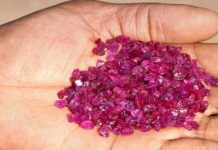


The Ministry of Finance has revealed that the government is forecasting a 3% increase in ruby production in 2026, targeting 4,062,546 carats, up from 3,944,219 carats expected this year and 3,946,506 carats produced in 2024. The increase is linked to the temporary halt in output from the country’s third-largest ruby producer, highlighting both the resilience and volatility of the sector.
Currently, roughly 70% of Mozambique’s ruby output is destined for export, a figure the government aims to raise to 79% by 2029. Yet the first quarter of 2025 saw ruby export revenues fall sharply by 30% year-on-year to $5.1 million, down from $7.2 million in the same period of 2024, reflecting both global market dynamics and local operational challenges.
Central to these challenges is Gemfields’ Montepuez ruby mine, the world’s largest ruby producer. The company has postponed its usual end-of-year ruby auction to early 2026, citing repeated disruption by hundreds of illegal miners daily at the new processing plant under construction in Cabo Delgado. Gemfields said illegal mining not only disrupts factory operations but also depresses market prices and reduces Mozambique’s tax revenues.
Gemfields and Montepuez Ruby Mining (MRM) are pressing ahead with plans to triple processing capacity to 600 tons per hour at the northern Mozambique mine. The second processing unit, PP2, is a cornerstone project for increasing premium ruby output and boosting revenues. The expansion also opens the door to further growth across MRM’s 34,966-hectare concession, which currently employs 1,300 workers, 94% of whom are Mozambican.

MRM, 75% owned by Gemfields and 25% by Mozambican partner Mwiriti, has invested $70 million in the expansion. Despite operational disruptions, the project underscores Mozambique’s ambition to strengthen its position as a global ruby supplier and maximise the economic potential of its rich gem resources.