




From pipelines to closed vessels, modern transmitters deliver reliable readings for liquids, gases and vapours, even when condensate forms or temperatures swing.
Process-pressure measurement is essential for monitoring relative and absolute pressure in pipelines and closed vessels across a wide range of production systems. Modern transmitters can measure liquids, gases and vapours reliably, even where condensate forms or temperatures change rapidly.
With measuring ranges extending from vacuum to extremely high pressure, these instruments suit diverse industrial applications. Integrated self-monitoring further supports operational reliability, while the dry ceramic-capacitive measuring cell provides:
- excellent overload resistance;
- long-term stability; and
- effective compensation for temperature shocks.
Together, these capabilities ensure consistent performance under demanding process conditions.

Selecting the right measuring cell
The medium being measured determines whether a ceramic or metallic measuring cell is most suitable. VEGA pressure sensors are available with either measuring-cell type or with customisable diaphragm seals, enabling each solution to be matched to the specific process requirements.
Hydrostatic level measurement
Pressure sensors determine level by detecting very small changes in hydrostatic pressure. As the liquid level rises or falls, the pressure changes accordingly, and the measuring cell records that variation.
Users can select ceramic-capacitive or metallic measuring cells for reliable pressure and level measurement in tanks, pipelines, basins and natural bodies of water such as lakes.
This method can also monitor product temperature, providing a more complete view of process conditions. Hydrostatic pressure measurement is unaffected by foam or internal vessel installations, so readings remain accurate in complex or turbulent environments.
By selecting suitable measuring cells, process connections and housing materials, users can adapt the sensor precisely to each process and achieve both versatility and accuracy.
Installation options
Compact pressure sensors can be installed directly on vessels, either from below or from the side, to suit the application. In wells and open channels, submersible pressure transmitters offer two practical options: suspension above the measurement point or secure mounting with a process fitting.
Pressure-sensor portfolio
VEGA offers solutions for both basic and advanced applications:
- VEGABAR Basic: models 28, 29 and 38;
- VEGABAR Pro: models 81, 82 and 83 for more demanding applications; and
- Submersible sensors: VEGAWELL 52, VEGABAR 86 and VEGABAR 87.
This range provides an appropriate configuration for virtually every hydrostatic level-measurement scenario.
Conventional differential pressure measurement
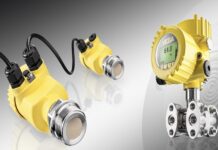
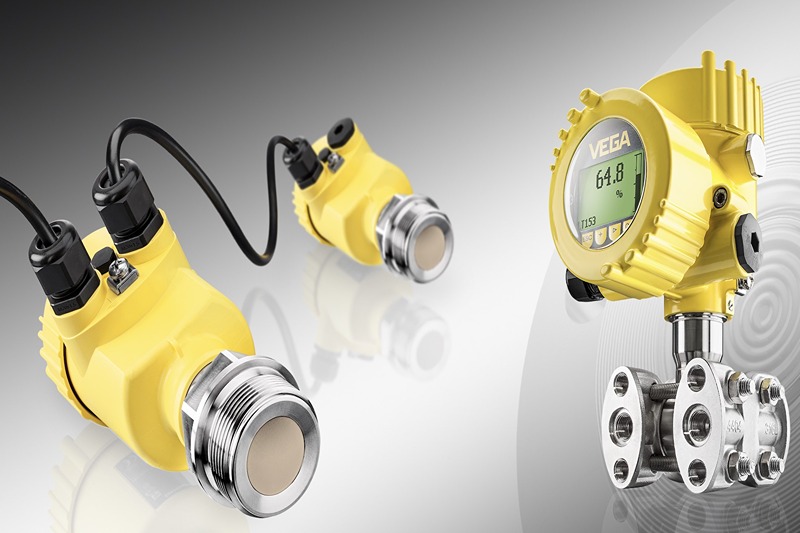
Differential pressure sensors use a metallic measuring cell and are particularly effective where high static pressure must be managed while very small pressure differences are detected. Their compact, robust design supports efficient integration into complex systems and delivers the accuracy required when even slight pressure variations must be monitored.
Chemical seals
Chemical seals, including the CSB and CSS variants, are a notable option within this category.
Designed for applications involving large pressure differences and high static pressure, chemical seals typically incorporate an overload diaphragm. This protects the sensor against unexpected pressure surges, improves operational reliability and extends equipment life where process conditions fluctuate unpredictably.
The VEGADIF 85 combines broad applicability with dependable operation. Its integrated overload protection helps maintain consistent performance in harsh conditions while safeguarding both the measuring cell and the integrity of the readings.
Electronic differential pressure measurement
Electronic differential pressure systems combine two pressure transmitters, often from the VEGABAR PRO series, into one measurement system. Key advantages include:
- reduced sensitivity to environmental influences such as ambient-temperature fluctuations;
- flexible sensor configurations and measuring-cell options; and
- straightforward adaptation to specific applications.
Electronic differential pressure systems are easy to install, assemble and maintain, helping to minimise downtime and reduce lifecycle costs. For applications such as monitoring pressure overlays in vessels, sensors from the VEGABAR 80 series can be combined seamlessly.
This modular approach addresses demanding conditions, including:
- large temperature differences;
- vacuum conditions;
- abrasive media; and
- cost-sensitive installations requiring minimal complexity.
A versatile measurement approach
Whether conventional or electronic differential pressure technology is used, modern industrial measurement solutions provide the precision, adaptability and reliability required across a broad range of demanding applications.
Contact www.vega.com for more information