




Moving high risk explosives across long and fragile supply routes is one of the hardest logistical problems facing remote African mines and BME, an Omnia Holdings company, says it has found a way to avoid much of it.
The company has engineered modular, containerised emulsion plants that make explosives on site, giving mines a secure and reliable supply without depending on distant deliveries. Emulsion is the explosive base that is pumped into blast holes. BME’s Production and Logistics General Manager, Dirk Voogt, said traditional supply models in regions such as West Africa and remote southern Africa face pressure from long distances, fragile logistics chains, fluctuating demand and strict safety and environmental regulations.
“Our on-site modular emulsion plants provide a secure, continuous and independent supply of high-quality blasting explosives while significantly reducing the need to transport higher-risk Class 1 products over long, hazardous distances,” said Voogt. The risk profile changes because of what the plants handle. Most of the raw materials are classified as Class 5.1 oxidizer, which are chemicals that can feed a reaction but are not explosives in themselves. Voogt explained, “The emulsion only acquires the detonation potential similar to a true Class 1.1 explosive once it is chemically sensitised and pumped into the blast hole. This fundamentally changes the risk profile of the supply chain and removes the need for high-security magazine facilities for finished blasting material on site.”
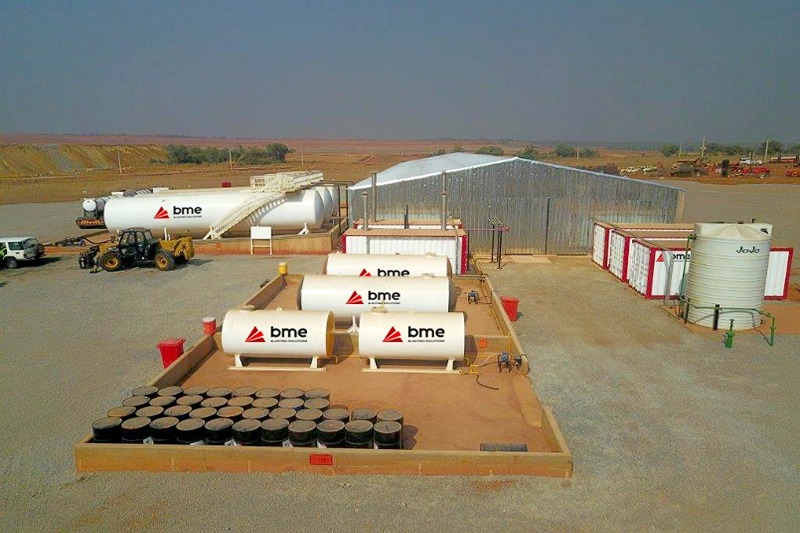
Class 1.1 is the category for explosives that pose a mass explosion hazard. On site production also reduces the risk of product contamination that can occur during long distance transport. Voogt said the plants draw on more than 40 years of engineering development and that speed of installation is central to their appeal. He explained, “Built into standard shipping containers and supplied with all required assembly tools, they can be unpacked and commissioned rapidly even at isolated sites.” The self supporting modules can be installed on compacted hardstands or basic concrete plinths rather than extensive reinforced concrete structures. In addition, Voogt noted, “Utilities connect through predefined interfaces, so site preparation can run in parallel with plant fabrication. This shortens project timelines and reduces construction risk at remote sites where specialist contractors and quality materials are often scarce.”

Capacity ranges from 20 tonnes of emulsion in an eight hour shift to more than 40 tonnes, so a plant can be matched to a mine’s production profile. “Preassembled and factory-tested modules deliver predictable commissioning and a rapid ramp-up to nameplate production capacity. The modular design also allows capacity to be scaled by adding modules as operational demand grows,” said Voogt. Nameplate capacity is a plant’s maximum rated output. When mine layouts change or new projects start, the plants can be dismantled, moved on standard flatbed trailers and redeployed at far lower cost and with less disruption than fixed facilities. He added, “Standardised modules ensure consistent maintenance, spares and control systems across the fleet.” Voogt said safety and process integrity are engineered from the start.
Moreover, he said, “Multiple layers of process safety including redundancy on flow and pump systems, mechanical safeguards including world class pump safety protection including electronic as well as mechanical safety trips, such as bursting discs, and rigorous HAZOP studies mirror the standards applied at BME’s stationary facilities.” HAZOP studies are structured reviews of what could go wrong in an industrial process. Automated digital process control and a data historian, which records how the plant runs over time, further reduces dependence on operators and provides full traceability. “The plants can also produce BME’s high-viscosity dual-salt formulations, including INNOVEX 300™ which is designed to perform reliably in dynamic water and variable ground conditions,” noted Voogt.
The plants can also process used oil as a fuel agent, which supports circular economy goals and helps mines progress toward their ESG targets. He explained, “On-site manufacturing shortens transport distances, cuts the carbon footprint of long-haul logistics and creates opportunities for local sourcing of raw materials and community-linked SME development.Structured training and digital learning materials further build local technical skills.” Voogt reported that BME has deployed these systems in some of Africa’s most demanding environments, including Mali, Mauritania, Burkina Faso, Sierra Leone, the Democratic Republic of Congo and Angola. “In each case, they have operated reliably under extreme temperatures, dust-laden atmospheres, limited infrastructure and constrained specialist support,” said Voogt.
The plants also plug into BME’s wider blasting ecosystem, which includes INNOVEX emulsions, AXXIS electronic initiation systems, digital tools such as XPLOLOG and XPLOCHARGE, and mine to mill optimisation solutions. “This allows customers to align product formulation, blast design and downstream processing for measurable gains in fragmentation, recovery and energy efficiency,” added Voogt. Fragmentation describes how finely blasted rock breaks up, which affects how much work the processing plant must do. The case rests on turning a traditional supply challenge into a lasting competitive advantage. “This gives mines greater control, lower logistical risk and a stronger foundation for long-term productivity,” concluded Voogt.
Gulf Suitor Circles a Mine That Mozambique Cannot Afford to Lose
One of the world’s largest titanium mines, in Mozambique’s Nampula province, could soon have a new owner, after investors from the United Arab Emirates submitted a proposal to buy Kenmare Resources plc, the Irish company that owns the Moma concession.
Kenmare, which operates the Moma heavy mineral sands mine, told financial markets that it has received a non binding proposal from International Resources Holdings RSC Ltd, known as IRH and based in the United Arab Emirates, regarding a potential cash offer for the entire issued and to be issued share capital of the company. Non binding means IRH is not obliged to proceed. The Kenmare board said discussions are continuing but cautioned that “there is no certainty that a firm offer will be made, nor as to the terms of any offer, should one materialise.”
Under Irish takeover rules, IRH has until 17 November 2026 to announce either a firm intention to proceed or a decision to withdraw. The prize is considerable and according to data previously presented to investors, Moma accounts for approximately 6% of global titanium supply and its mineral reserves have an estimated operational life of more than 100 years.
The approach comes against a backdrop of unresolved fiscal talks with the Mozambican state. The Implementation Agreement that governs the concession’s fiscal and operational conditions expired in December 2024, and Kenmare continues to operate under the previous terms through official authorisation from the Mozambican government. In May, the company said negotiations to renew the agreement were constructive, while acknowledging that international arbitration remained an option if no deal could be reached.
Kenmare said it had responded to the government’s desire for more revenue from Moma with several proposals offering enhanced terms and that Chief Executive Officer Tom Hickey met Mozambican President Daniel Chapo twice in 2025. According to the company, Chapo stressed how important Moma is to Mozambique and expressed the government’s intention to renew the agreement, although no timeline has been set for concluding the process.
The company maintains that any dispute over renewal does not affect the mine’s physical operations, because it centres on fiscal matters, royalty payments and conditions tied to the industrial free zone regime. Kenmare, which is listed in both London and Dublin, says it remains focused on reaching a settlement. Chapo said in March that neither side had suspended negotiations or chosen the path of arbitration, and that the government continues to engage in dialogue, whether with Kenmare or with Mozal, the aluminium smelter in Maputo that is the largest in Africa. “We believe that within these negotiations we are carrying out, it is possible to find solutions. Absolutely, because it is through dialogue that we reach common ground,” said Chapo
The numbers show a mine operating under pressure. Kenmare says it has invested $875 million in Moma to date. Production of heavy mineral concentrate, the raw material from which titanium bearing minerals are separated, fell 15% in 2025 to 1,233,300 tonnes, while exports declined 13% to 947,900 tonnes. Amid the uncertainty, Kenmare has recorded impairment charges of $301.3 million, which are accounting write-downs that reduce the book value of an asset but it projects total ore exports of 1.1 million tonnes this year. Whether the proposal turns into a firm offer should become clear by 17 November.
Second Act Beckons for Elizabeth Bay Mine
Dutch investor Kenzoll Capital has partnered with MSF Commercials to restart the Sperrgebiet Diamond Mine, formerly known as Elizabeth Bay, near Lüderitz.
The licences cover 245 364 hectares of the Sperrgebiet, roughly 2,450 square kilometres and hold estimated resources of 6.3 million carats onshore and 4.2 million carats offshore, or 10.5 million carats in total. A carat is the standard unit of weight for diamonds and resources are estimates of what lies in the ground, not proven reserves.
Kenzoll says its investment could reach N$828.5 million, subject to regulatory approvals, as the partnership widens exploration beyond diamonds into heavy mineral sands and critical metals.