





MAPUTO – Italian energy major Eni is evaluating the development of a third floating liquefied natural gas (FLNG) platform in Mozambique’s offshore Rovuma Basin, the company said on Monday, looking to expand its footprint in one of Africa’s most prolific gas frontiers.
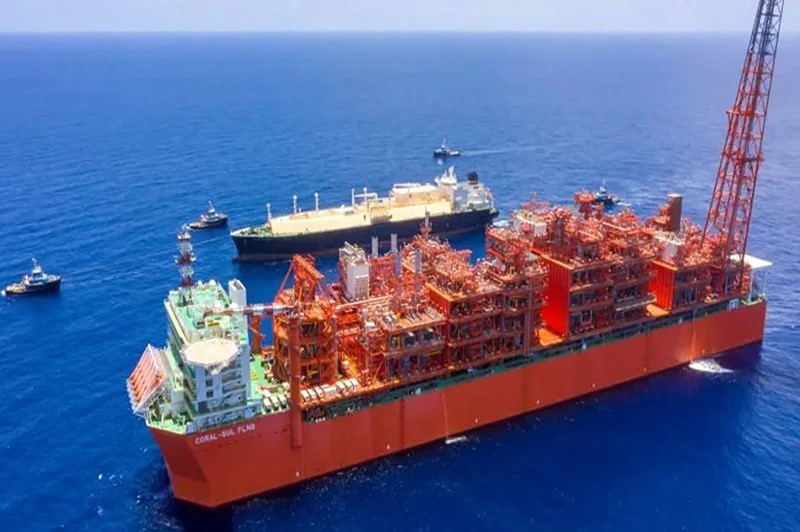
The state-backed oil and gas firm already operates the Coral South FLNG facility and recently greenlighted a second multi-billion-dollar project, Coral North, which is scheduled to start commercial production in 2028.
“The basin has significant natural gas reserves, allowing not only the implementation of ongoing projects but also creating opportunities for new developments,” an Eni spokesperson told news agency Lusa on Monday. “In this context, Eni is currently assessing the possibility of moving ahead with a third project based on FLNG technology, whose success has been demonstrated by the Coral South FLNG project.”
The announcement underscores Eni’s aggressive infrastructure deployment in Mozambique’s ultra-deep waters, where it prefers fast-tracked, modular floating platforms over massive, politically sensitive onshore developments.

Speaking at a signing ceremony in Maputo on October 2, Eni Chief Executive Claudio Descalzi confirmed that the consortium had reached a Final Investment Decision (FID) on the $7.2 billion (€6.2 billion) Coral North project.
“We have initiated the schedule for 2028. This means we started today with the FID and, within three years, we will begin production,” Descalzi said, noting that the project would double the country’s current output to 7 million tonnes per annum (mtpa).
The rapid expansion will position Mozambique as the third-largest LNG producer in Africa, trailing only Nigeria and Algeria.
The Coral North project was formalized in the presence of Mozambican President Daniel Chapo by Area 4 consortium partners, which include Eni, China’s CNPC, South Korea’s Kogas, Mozambique’s state-owned ENH, and XRG.
Floating LNG infrastructure has become a crucial economic driver for the southern African nation, which has struggled with fiscal instability and a northern Islamist insurgency that crippled other land-based mega-ventures.
According to Descalzi, the operational Coral South platform which has exported more than 120 LNG cargoes since it went online in 2022 accounted for roughly 50% of Mozambique’s gross domestic product (GDP) growth in 2023, and is projected to drive about 70% of GDP growth in 2024. Over its lifespan, Coral South is expected to generate $16 billion in tax revenues.
The upcoming Coral North project, designed as an “improved replica” of the first platform, is forecast to yield an additional $23 billion (€20.1 billion) in state revenue over its 30-year operational life, while doubling local employment.
“A few years ago… everyone said it was impossible. Now we are already on the second development, something everyone could have considered technically impossible,” Descalzi said.
Mozambique holds some of the largest natural gas reserves in the world, split across three mega-developments in the Rovuma Basin. Alongside Eni’s offshore floating projects, France’s TotalEnergies is developing a 13-mtpa onshore facility which recently resumed activities following security pauses, while U.S. major ExxonMobil is advancing plans for an 18-mtpa onshore plant on the Afungi peninsula, pending a final investment decision.